


Interrotron
The Interrotron captures testimonials and interviews while maintaining direct eye contact with the camera. Little known outside specialist circles, this professional tool is widely used in cinema and high-end communications.
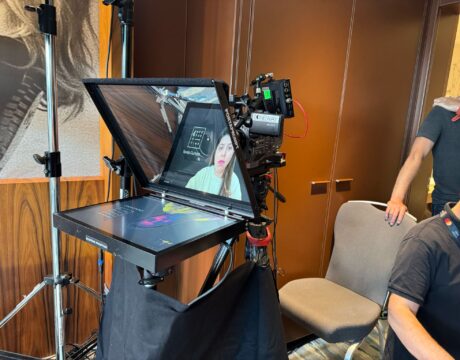
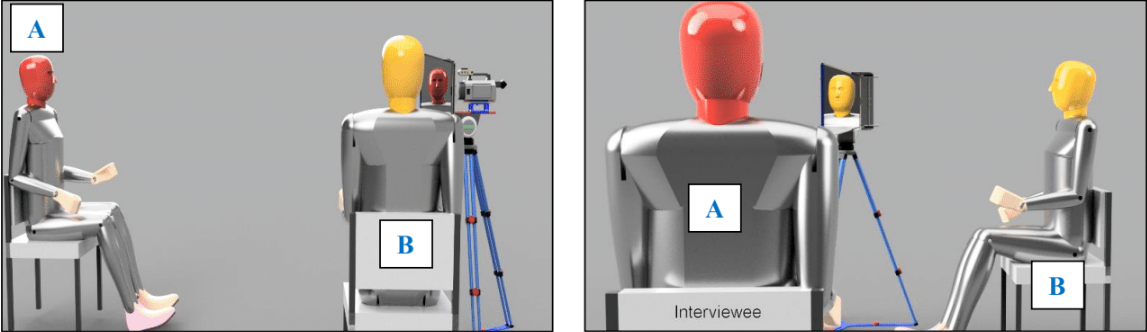
An Interrotron is a filming device that allows the person on camera to look directly into the lens while seeing their interviewer’s face. The system uses two teleprompters placed as mirrors: one displays the interviewer’s face in front of the camera filming the interviewee, and the other displays the interviewee’s face in front of the interviewer’s camera.
The result is striking: viewers feel as though the person on screen is speaking directly to them, while the subject remains perfectly at ease — because they see a human face rather than a cold, impersonal lens.
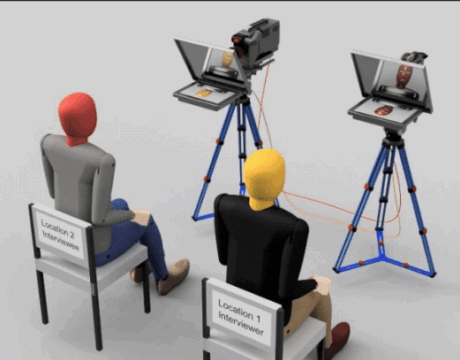
The main purpose of the Interrotron is to create a more natural, more engaging connection. It is particularly useful when sincerity and emotion are essential: executive interviews, sensitive documentaries, brand-led advertising or client testimonials. It is also widely used in press days and pre-release film junkets.
This device:
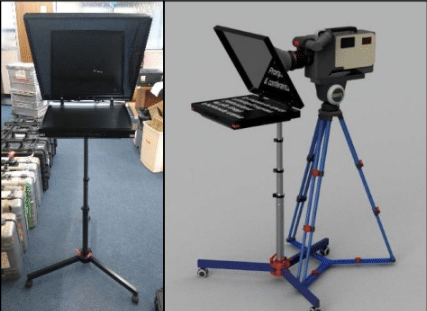
Confusion between a teleprompter and an Interrotron is common, as both devices use a semi-reflective mirror positioned in front of the camera. However, their use, purpose and impact on a shoot are very different.
A classic teleprompter is designed to display scrolling text. It is primarily used to help a speaker read their speech while looking at the camera, in a fluid and natural way. It is commonly used in political addresses, TV news or corporate videos. The prompter structures a message, but creates a form of distance: the speaker addresses the camera, but is not looking at anyone.
The Interrotron, on the other hand, does not show text — it shows a human face. It allows the person being filmed to see their interviewer through the camera lens. It is a tool that radically transforms the dynamic of an interview or testimonial: the exchange becomes human, fluid, almost intimate. The gaze is more alive, more expressive, and the viewer’s emotional engagement is far stronger.
In summary:
| Teleprompter | Interrotron |
|---|---|
| Displays text | Displays a face |
| Used for speeches | Used for interviews |
| Rigid structure | Fluid dialogue |
| Can fix/stiffen the gaze | Humanizes the exchange |
The Interrotron was invented by American filmmaker and documentary maker Errol Morris. Known for his powerful investigative films and intense interviews, Morris was looking for a way to capture speech that felt more truthful and more embodied. He wanted his subjects to be able to look at the camera without losing human contact — without being frozen by an impersonal lens.
By combining two teleprompters, he devised a system where the interviewee sees the interviewer’s face directly, while keeping their eyes turned towards the camera. The device was initially improvised, but its effects quickly proved spectacular: the people filmed appeared more natural, sometimes more vulnerable, but above all more sincere. The Interrotron became Errol Morris’s visual signature, most notably in his celebrated documentaries such as The Fog of War.
The invention has since spread beyond film, particularly into advertising, corporate communications and visual journalism — always with the same ambition: to capture authenticity.
The cost of an Interrotron depends on the type of shoot, the equipment used and your technical requirements. At Solutions Prompteur, we offer tailored rental solutions throughout France and internationally.
Contact us for a quote adapted to your project.
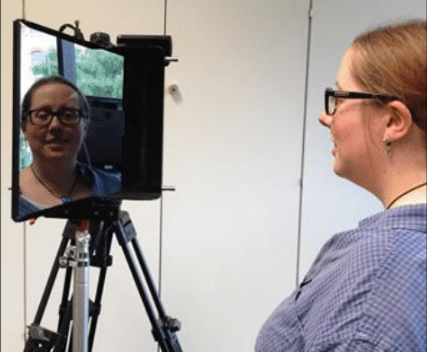
There are several methods to simulate a more natural camera gaze, but none truly replicate the direct, intimate effect of the Interrotron.
Some filmmakers use off-axis interview techniques, or simply place a face behind the camera. This can work… but the result is often less fluid, less instinctive, and above all less professional.
The Interrotron allows a genuine face-to-face exchange, without compromise.
At Solutions Prompteur, we have adapted the Interrotron to real-world production demands.
Our devices are compact, reliable and designed to integrate into all types of shoots: sensitive interviews, corporate videos, documentaries, strategic speeches…
Our operators handle installation, live management and all necessary technical adjustments to ensure an optimal result.
The goal is simple: to guarantee a fluid, natural and sincere exchange for your subjects — as if they were speaking directly to their audience.
A discreet tool, but devastatingly effective for content with strong human value.
No, the Interrotron is not designed for reading text.
It projects the interviewer’s face, not a script. The purpose: to create a natural camera gaze while preserving a human exchange.
If a speech needs to be read, we switch to a classic teleprompter. We help you make the right choice based on the nature of the intervention.
Because the gaze changes everything.
An Interrotron captures a sincere testimonial, elevates powerful speech, and creates an immediate connection with the viewer.
It reinforces the credibility of a message, humanises a corporate communication, and elevates an artist portrait.
If your content aims for emotion, attention or trust, the Interrotron is a powerful ally.
At Solutions Prompteur, we know this: it is not just a tool — it is a revealer.
Yes, the Interrotron can be adapted to the majority of camera configurations.
Whether compact bodies, cinema cameras or broadcast models, our systems are designed to integrate without constraint.
We ensure every installation is perfectly aligned with your technical requirements, whether in-studio or on location.
The choice depends primarily on the type of capture you need.
For a prepared, structured speech, the teleprompter remains the reference for reading text while maintaining a camera gaze. Several types are available for different contexts:
For more authentic exchanges, interviews or testimonials, the Interrotron fosters a natural connection with both interviewer and audience.
We guide you to the right decision based on your needs and the outcome you’re aiming for.

