TELL US ABOUT YOUR PROJECT HIRE WITH DEDICATED OPERATOR

Everything you need about teleprompters — starts here.

By the team operating them for 20 years.
Solutions Prompteur - Lucia écharpe rouge présentation
Everything you need about teleprompters — starts here.

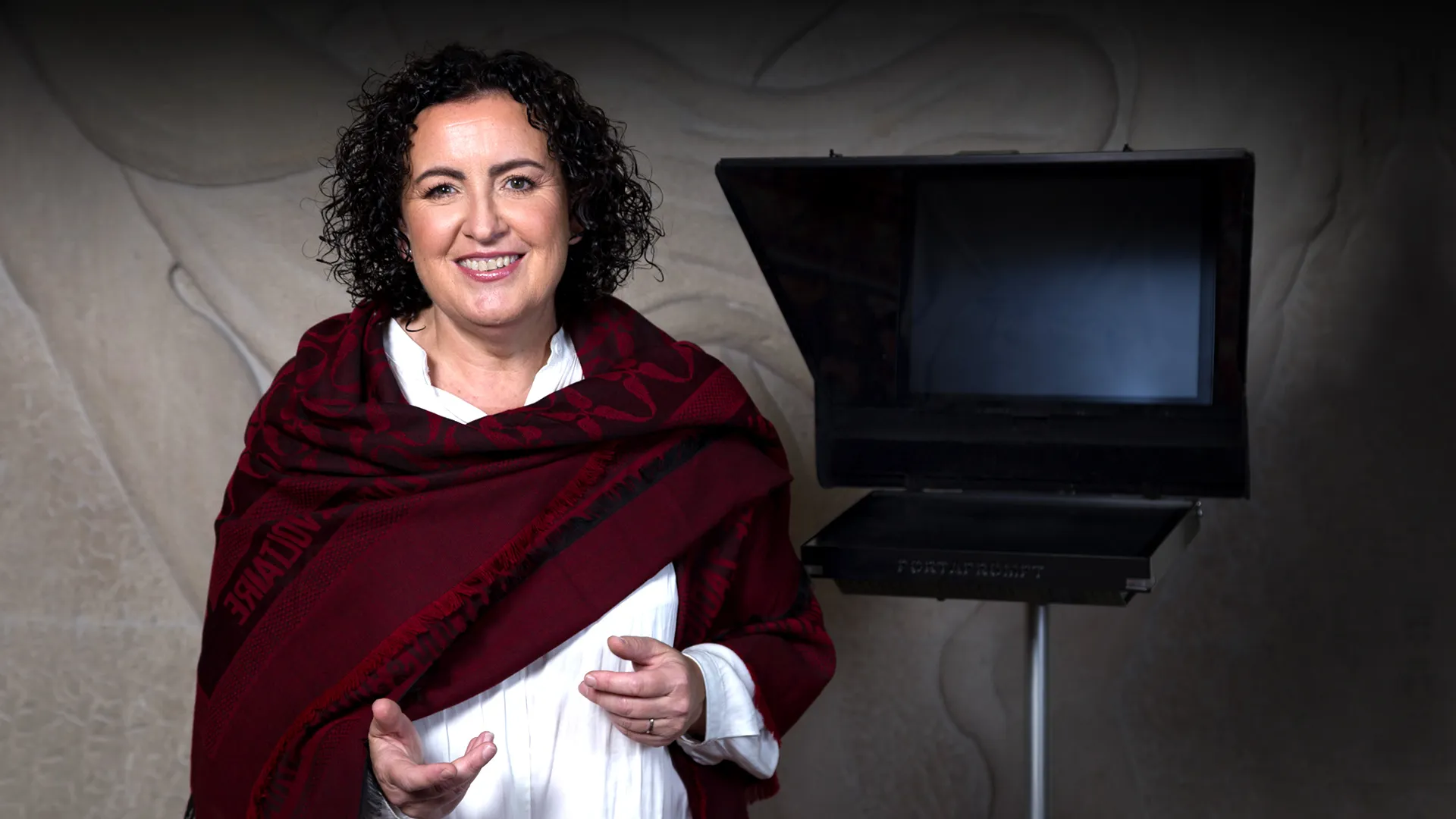
I’m Lucía Arribas, and this is my proposal:

I make speeches given by some of the most influential people in the world (and the most demanding) more impactful with a 0% error rate.

This frees up time for event project managers, who can devote this time to concentrate on other tasks in the event, and gives them ease of mind in the knowledge that there will be no technical breakdowns with the prompter.

Apart from explaining how I achieved this 0% technical error rate…

With over 20 years of experience, I am sharing my tips I have
observed from some of the most sought-after project
managers I have worked with in France and around the world.

These details will help them avoid a host of coordination errors so that they can better control their events. This, inevitably, will boost their prestige.

I am sharing this with all the project managers already on my mailing list.

If you are interested in having access to this information, you can sign up below:

Your email address is only used to send you our information.
You can use the unsubscribe link integrated into the list at any time.
Learn more about managing your data and your rights.

I accept the privacy and cookies policy

*You can unsubscribe from our mailing list at any time

So how do you choose the safest and most suitable prompter solution for your event ?

Let’s get to know one another in first name terms, because let’s face it, we’re probably working in the same circles.

Here, I could say things like “Contact us because whatever your project…” or “we have professional prompter solutions for all events…” or “turnkey solutions” …and that would be the truth.

But if I told you that, I wouldn’t be telling you very much.

Let’s be more concrete.

Would you prefer to know the limits of each type of prompter to best match your client’s demands…

…and to avoid making promises that could leave you in a sticky situation later on?

I admit it, I’m obsessed with technical mastery and anticipation.

If you’re interested too, then I’ve prepared a booklet that might interest you.

This booklet contains everything a project manager needs to know about the prompter (short and without technical jargon) and it’s called:

Increase your authority in front of your client
(in 5 minutes) and avoid the “No problem sir” syndrome

In concrete terms, I’m talking about…

✔ The question to ask an important client straight away when they ask you for an "Obama" conference glass pane prompter at the last minute.

The approximate time needed to set up each prompter.

✔ What few production managers know about the camera prompter, and what you should know if you want to shoot content with a moving camera. One project manager didn't know this, and it really embarrassed her on the day of the shoot…

✔ Two solutions that you can already propose to your client to make things easier when asked for a stage prompter.

✔ How the "No problem sir” syndrome can seriously jeopardize the success of an event.

✔ The only case where accepting a request for a wireless prompter (or a Steadycam) is suicide... and we know this because we invented the system.


If you want to understand what each type of prompter can do and assure your role as a professional (be able to spot more problems at a glance) Make sure to provide your e-mail address:

Your email address is only used to send you our information.
You can use the unsubscribe link integrated into the list at any time.
Learn more about managing your data and your rights.

I accept the privacy and cookies policy

*You can unsubscribe from our mailing list at any time

Interested and would like to learn about the different
types of prompter?

Our types of teleprompters

Need the best prompter fast to match your event needs, contact me here.

Lucia Arribas signature
Lucia ARRIBAS
Founder
SOLUTIONS PROMPTEUR

Frequently asked questions about teleprompters

What are the benefits of a teleprompter compared to speaking without support?

A teleprompter frees the speaker from memorisation so they can focus on what matters most: connecting with their audience. The result — sustained eye contact, a fluid delivery, the exact message intact, and significantly reduced stress. For an event project manager, it’s the guarantee that the approved text will be delivered exactly as written, with no last-minute improvisation or forgotten lines.

Beyond speaker comfort, a teleprompter has a direct impact on production efficiency: fewer takes during a shoot, fewer rehearsals needed, tighter schedules respected. The speaker can naturally scan the room, pause for effect, react to applause — without ever losing their thread. A shoot that would normally take half a day can often be wrapped in a few hours.

Cue cards systematically break eye contact — every glance downward loses the audience. A teleprompter positions the text within the speaker’s line of sight: they read without anyone seeing them read. On camera or on stage, the difference is immediate: greater presence, more natural delivery, a message that feels fully mastered.

Cue cards also create a flexibility problem: a last-minute edit means reprinting, redistributing, and risking version confusion. With a teleprompter, the text is updated in real time from the operator’s computer. No physical handling, no noise, no risk of disorganisation. The speaker only ever sees the final version.

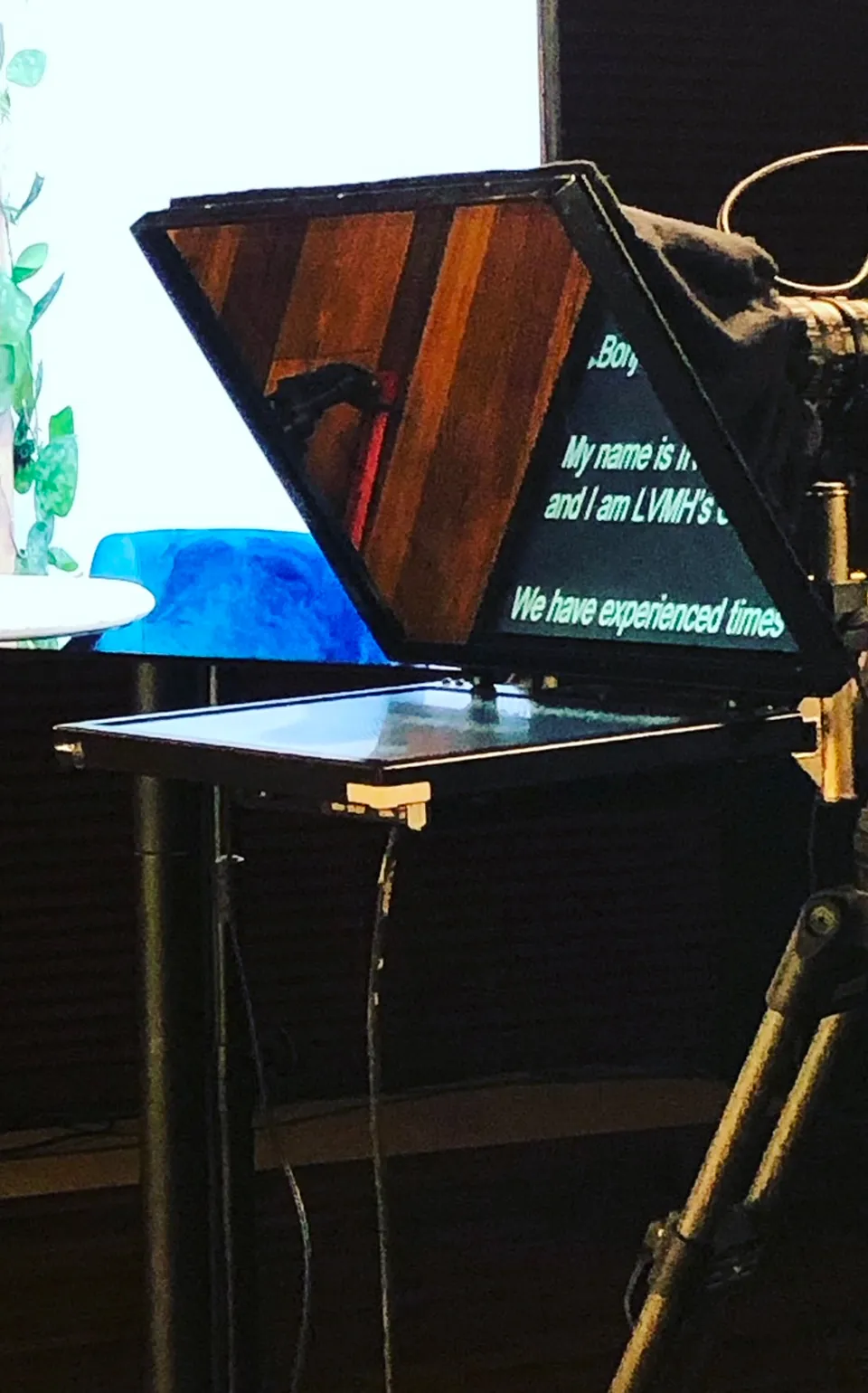
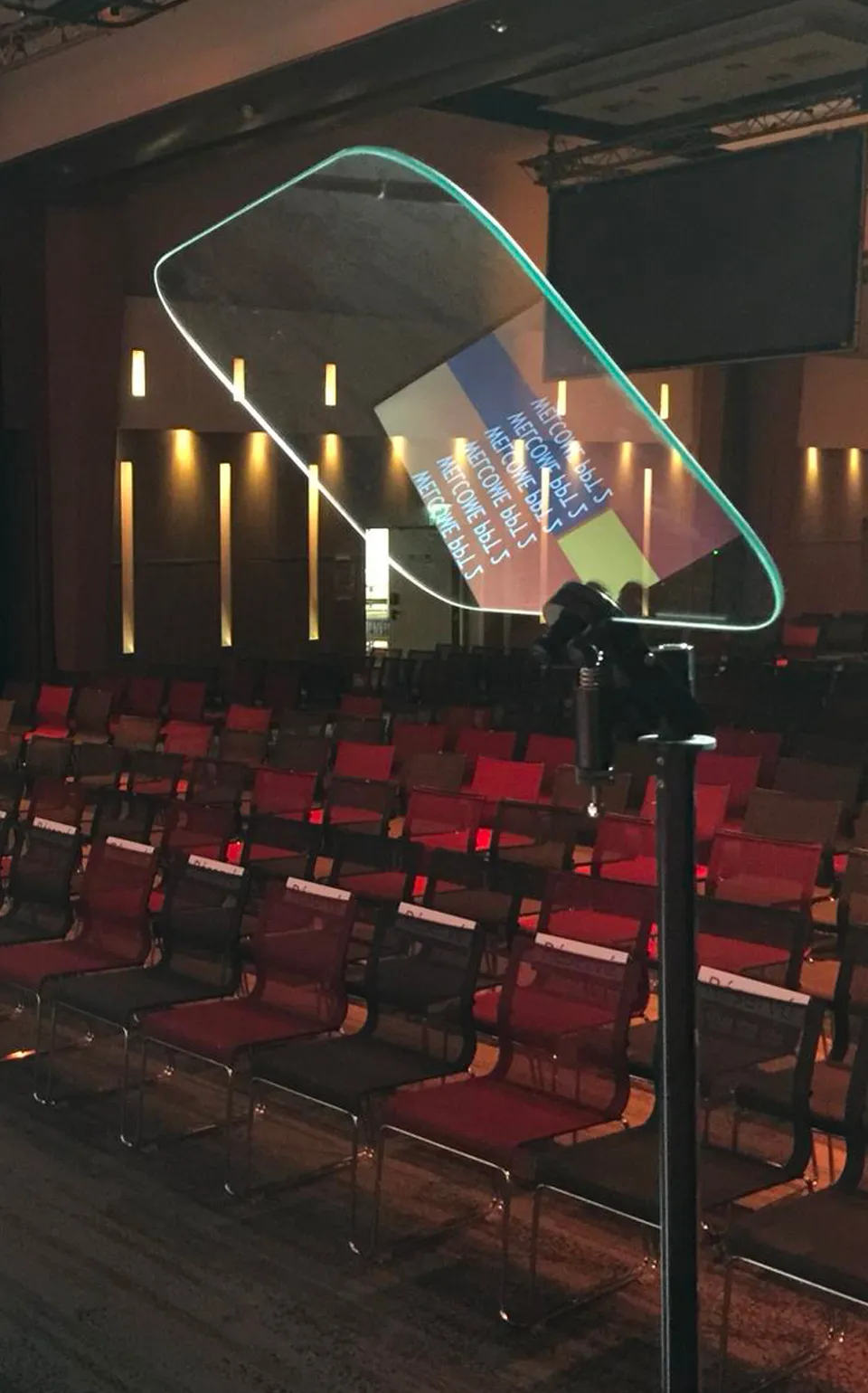
No. The conference teleprompter (Obama-style) uses semi-reflective glass panels: the text is only visible from the speaker’s side — the audience sees only a perfectly transparent pane of glass. The camera teleprompter is positioned in line with the lens — no text appears in the frame. In both cases, integration is total.

The glass works on the same principle as a one-way mirror: the reflection only functions for the speaker positioned at the focal point. From the audience’s side, it’s completely transparent. Our rigs are also fitted with custom-made covers (black, white, or colour-matched to the décor) to ensure even the structure remains invisible. This level of discretion is particularly critical for presidential events, live TV broadcasts, and official press conferences.

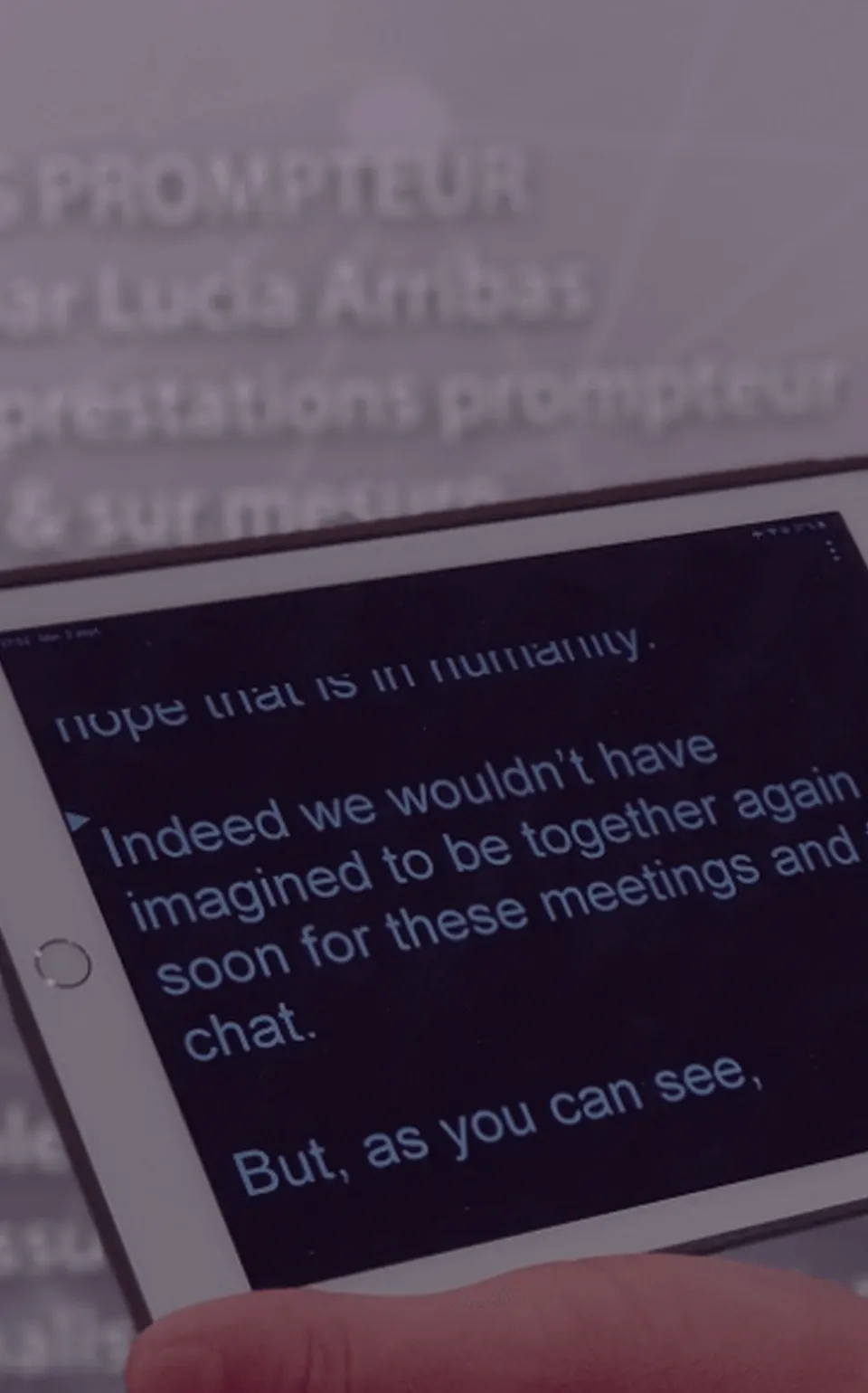
No — and that’s precisely what makes it a professional tool. The text is scrolled manually by an experienced operator in real time, adapting the pace to the speaker’s rhythm, managing pauses, applause, and improvisations. No algorithm can replicate that.

The operator and the speaker form a true silent partnership. The operator anticipates accelerations, slows on key moments, holds pauses, and can freeze the scroll if the speaker goes off-script. This human sensitivity is irreplaceable, particularly at high-stakes events where a half-second delay can throw an entire intervention off balance. Voice-activated or pedal-controlled systems simply don’t offer this level of responsiveness.

Three criteria are enough: the context (stage or camera), the speaker’s mobility, and the venue’s technical constraints.

Speech in front of an audience → conference teleprompter (Obama-style): two glass panels either side of the lectern, invisible from the floor
Recording or broadcast → camera teleprompter: text aligned with the lens for direct eye contact
Mobile speaker or large space → stage teleprompter or wireless
Each setup has its own technical specifics. The Obama-style teleprompter lets the speaker naturally scan the room from left to right. The camera teleprompter ensures perfect direct eye contact with the lens. The stage teleprompter can be positioned up to 15-20 metres away depending on monitor size. Combinations are possible for large-scale events. If in doubt, our team can assess your setup and advise in minutes — often over the phone.

Yes, and that’s our job. The rigs are fitted with custom-made covers, cabling is concealed, and everything is in place before the audience arrives. The equipment adapts to the existing stage design — not the other way around.

Our integration solutions cover all configurations: TV studios with lighting constraints and anti-glare requirements, large corporate stages with complex décors, official ceremonies with strict protocols. We systematically carry out a technical assessment beforehand to identify the best reading positions, power supply points, and concealment options. For premium events, high-end finishes (noble materials, bespoke rigs) are available on request.

Yes, with the right equipment. For outdoor conditions, we use high-brightness monitors (minimum 2,000 nits) and, depending on light intensity, solid glass panels in place of standard reflective glass to guarantee optimal reflection. This technical adaptation, drawn from 20 years of outdoor experience, ensures flawless readability even in direct sunlight.

Outdoor constraints go beyond brightness: wind, rain, temperature changes, and secure power supply all need to be accounted for. We anticipate every variable. For daytime events, tests are carried out at the scheduled intervention times to validate readability in real conditions. For evening events, brightness is adjusted accordingly to ensure reading comfort without creating a visible halo from the audience’s side.

Reading distance depends primarily on monitor size. For the camera teleprompter: a 32″ monitor allows reading up to 15-20 metres, a 24″ up to 10-12 metres, a 17″ up to 4-6 metres. For the conference teleprompter, the optimal distance is 2 to 5 metres, with multiple reading points possible across the stage.


From first contact, we assess your needs, recommend the right equipment, and provide a quote within 24 hours. On the day, the team arrives early for a full installation (45 minutes on average), MAIN and SPARE system testing, and a run-through with the speaker where possible. The operator remains on hand throughout the event. We operate across France — typically within 48 hours — and internationally in over 38 countries.

The full process runs in three phases. Before: initial contact, technical proposal, quote, approval, deposit, logistics. During: installation and testing, professional text formatting with backups, continuous operator support, real-time handling of any unexpected changes. After: careful breakdown, GDPR-compliant archiving of all texts, invoice, and debrief if required. For sensitive assignments (political, institutional, diplomatic), full confidentiality is guaranteed at every stage.

We don’t wait for a failure — we prevent it. Every assignment is run with a MAIN and SPARE system: two complete, fully operational configurations running simultaneously. If an incident occurs on one, the switchover is instantaneous, with no interruption whatsoever for the speaker.

This protocol was developed by Lucia Arribas after years of working on high-stakes events — diplomatic, institutional, presidential — where a technical failure can have consequences far beyond the stage. In practice: two dedicated computers with no internet connection, redundant power supplies, doubled cabling, backup screens. All verified in our Paris workshop before every assignment, with a double operator check. In 20 years, this system has never failed.

Our headquarters are in Paris (17th arrondissement), with a permanent base in Cannes for events in the south of France. We work with both French organisations and international clients — including UK and European companies managing events on French soil. We also travel internationally, operating in over 38 countries.

For international clients organising events in France, we’re your local partner: bilingual team, strong knowledge of French venues and logistics, fast response across Paris and major French cities. For your own events abroad, we travel with our equipment or coordinate with trained partner operators in your country. Whether it’s a press junket in Cannes, a corporate conference in Paris, or an international summit abroad — the same level of operational precision applies.